
Selfish and Stupid
But doing it anyway

These days I consume zero climbing media. I haven’t done since the day I woke up in hospital.
Whereas I once refreshed UKClimbing 40 times a day, obsessively consumed climbing videos on YouTube, devoured the mountain classics of literature, and leafed through my sizable library of guidebooks planning future adventures, I now pretend that when climbing ceased to exist for me, it ceased to exist for everybody.
It is still the only way that I can cope. Whereas some people who are catastrophically injured through sport still take joy in watching others participate, for me it’s too painful. I cut myself off, and never looked back. Hence I’ve no idea if Adam Ondra is still the only person to have climbed 9c, or if that even remains the highest sport grade. Same goes for E12, for Burden of Dreams. I couldn’t even guess who won the men’s gold in 2024, though I’m going to assume that Janja won the women’s.
But even I heard about Alex Honnold climbing some building in Taiwan.
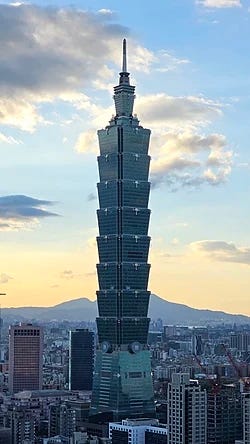
Before going any further, let’s get one piece of terminology straight. Honnold’s “achievement” (scare quotes to be explained in a moment) last week was not simply that he free climbed Taipei 101, but that he free soloed it. The distinction is important.1 Free climbing means ascending something without the use of devices to assist (“aid”) the physical moves themselves. However, assistive devices can be used whilst free climbing to prevent injury or death, should a climber’s un-aided physical moves come up short and they fall. (Think: harnesses, ropes, karabiners, et cetera.) By contrast, free soloing is free climbing, but without any of the assistive devices used to (in theory) prevent death if the climber should fall. In essence, free soloing reduces the margin of error to zero. If you fall, you die.
I free climbed literally thousands of routes before my accident. On a dozen or so occasions, I free soloed them.
A few people have cautiously asked me what I think of Honnold’s latest. My answer has generally been: “how the fuck am I the one in a wheelchair, and not him?” But there’s more to it than that.
As I don’t consume climbing media anymore, I don’t know what the general consensus is in the climbing scene regarding his latest spectacle. But I’d wager that most climbers had the same response as me: a rolling of the eyes.
This might seem weird. Isn’t free soloing a 500m building an impressive athletic and psychological achievement, and shouldn’t climbers respect that more than anybody? Putting aside for now (we will get there in a minute) furious debates between climbers about the acceptability of free soloing in general, my guess is that even people who free solo won’t have been positively disposed.
First, because although what Honnold did will look impressive to non-climbers, those who climb will know that it was nowhere near as hard (to him) as it looks. The now widely circulated footage of making what appear to be difficult moves on the tower are in fact not so for somebody with advanced climbing skills, which he undoubtedly possesses. Those moves are far below Honnold’s technical and physical limits. If you don’t climb, this will be hard to believe, but take it from me: for somebody of his ability, climbing Taipei 101 is about as difficult as going up a ladder. Sure, it’s not a good idea to fall off a 500m ladder. If you do, you will die. But if you don’t, you won’t.
And yes, it takes good mental composure to not panic, to be able to commit to something like that from start to finish. But this is hardly Honnold’s first rodeo. He has spent years free soloing, and thus has trained his amygdala such that a panic response is simply not going to happen to him, even at 400m off the ground. If you’ve never climbed a ladder before, then going even 20m up a ladder will likely cause you to quake with fear and be desperate to come down. But if you climb a thousand 20m ladders over the next 20 years, you’re not going to find it remotely difficult to safely climb another one tomorrow. (And trust me, once you are comfortable at 20m, you’re comfortable at 500.)
Which is not to say that none of Honnold’s achievements as a free soloist are impressive. Quite the contrary. He has previously pushed the limits of free soloing far beyond what was thought possible, and in a way every climber respects (even if only begrudgingly). When he soloed El Capitan in Yosemite, this was a moment of human accomplishment on a par with being the first to run 100m in under 9.8 seconds – except with the added twist of failure meaning certain death. The film Free Solo is genuinely worth watching, both as a piece of documentary evidence for what he accomplished, as well as an interesting insight into the rare psychology of the committed soloist, someone pushing the limits beyond what anybody thought the envelope would allow.
But that itself is now part of the problem. Taipei 101 is not El Cap. There is no beauty, in terms of the movement of a human body on rock, to be found in the capital of Taiwan. It is one thing to add potentially the most storied chapter to the grand history of Yosemite climbing, quite another to do a Netflix special. Not even Honnold is going to pretend – the soloist’s oldest defence – that there is a deep spiritual communion to be found in mechanically repeating moves on concrete blocks, filmed by a dozen cameras, as part of multi-million-dollar media operation.
And capped off by taking a selfie at the top.
I mean, he’s not even the first person to free solo tall buildings. Alain Robert has been doing it for years, usually illegally, and without making money from it. Where is his Netflix cash in?
In other words, my predominant response to Alex Honnold’s latest media acclaim is that I’m still a punk rock kid at heart: fucking sell out.
Sell out? Surely that’s not what matters most! Surely what matters most is that free soloing is selfish and stupid. Those are the primary sins. No?
Well, it’s complicated. Because yes, what he does is selfish, and it is stupid. And not just at Taipei 101, but anywhere. And I should know, because I’ve been selfish and stupid myself.
The day before my accident I free soloed North Face Route into Agag’s Groove on Buachaille Etive Mor in Glen Coe, a classic link up. To be clear, these climbs are trivial in difficulty compared to the solos that Honnold undertakes. Still, everything here is relative (except for the fact that falling would have meant instant death). And given my abilities back then, those routes were about as difficult for me as climbing a ladder. So I backed myself to be able to solo them. Correctly, as it turned out.
But it was still a stupid thing to do. I had never been on those routes before, and so I didn’t know their condition. If rocks break, you fall, even if you’ve personally done nothing wrong – as I was going to learn the hard way, less than 24 hours later. And when you climb solo, you climb fast (90% reduction in faff) – meaning it’s easy to go off route, ending up on much more difficult terrain than you had anticipated, exponentially increasing the chances of disaster.
I knew all this, and I did it anyway. Why? Because on a beautiful day in June, in glorious Scotland, the prospect of not climbing felt something like unacceptable. This was what I lived for. And yes, I knew I’d have a climbing partner the very next day, so I could easily just wait. But why should I wait? I backed myself to climb a ladder – a beautiful, life-affirming ladder, trusting entirely to my own abilities, in the gentle summer Sunday evening, after the hillwalkers had cleared out and left the mountain to me alone. Would you expect a heroin addict not to inject heroin today, just because they’ll have heroin tomorrow? This is what I mean when I say that I was addicted to climbing. And just like every junkie knows there’s a risk that he will OD, I knew that there was a risk that I would fall. But I didn’t care. In fact, I deliberately chose not to wear a helmet: if this was to be the end, at least let’s make it quick. Which was an easy decision to make, because I knew I wouldn’t fall. Or so I thought. You see, whilst it is well known that stupidity can make you confident, it turns out that confidence can make you stupid.
As for selfish, well that’s beyond doubt. I now have an especially keen sense of exactly why, having seen just how much pain I caused to friends and family in the aftermath of an accident that didn’t even kill me. But let’s not pretend I didn’t know this even before I ended my climbing career once and for all. One Christmas Eve, about five years before my accident, I went bouldering in a quarry in Lancashire near where my parents live. I noticed that one of the boulder problems continued into a trad route right to the top of the cliff. The guidebook confirmed that it was easy enough. So I completed the problem, and continued. Which rapidly stopped seeming like a good idea halfway up, in damp December conditions, truly losing control of my amygdala. The moves weren’t hard, but they suddenly seemed far from secure. In the end, I made it to the top without incident. But when I got there I felt no elation, no self-affirming satisfaction – as soloing typically delivers (why do you think it’s addictive?). I just felt like a selfish prick.
That night I lay in bed and imagined myself broken and alone on a quarry floor, dying slowly in the December drizzle, my corpse to be found by the first unfortunate Christmas dog walker. My family doesn’t have a great track record when it comes to festive cheer, and I’m hardly innocent in that regard, but even by my standards that would have taken the biscuit.
I didn’t solo again for a few years.
*
Precisely because free soloing is selfish and stupid, it is a controversial topic even amongst climbers. The vast majority of free climbers do not free solo. Some of my closest climbing partners would commit to doing very serious traditional climbing routes, and yet firmly draw the line at soloing. (And trad climbing definitely is serious, as proved by the cripple voice dictating these words.) They told me bluntly that I should never do it, and they didn’t like hearing about it when I had done it. So why did I do it?
There is an ancient Greek term, akrasia. It is sometimes translated as “weakness of will” – although I don’t like that translation, because it already narrows and contorts the field in ways that distort reflection. Nonetheless, akrasia refers to situations in which a person apparently acts against their own professed best judgement. For example, the student who knows that the best thing to do is stay home and prepare for tomorrow’s exam (the outcome of which is crucial to her final grade), and yet who nonetheless goes to the party and gets drunk. She knows and agrees and affirms that the best thing for her to do is to stay home and revise. But she not only does something else, she does it when she herself knows and agrees and affirms that it is a worse thing for her to do. She is akratic. We all are, sometimes.
But the stakes of akrasia are not always the same. Several years ago, I had been climbing with a close friend in Scotland, but was now driving back to London. Annoyingly the weather had been sketchy all week, and yet now was fantastic. The M6 was going to take me straight past the Lake District. And I’d still never been to the top of Ska Fell. A coffee break outside Carlisle gave me a chance to check the guidebook, which confirmed an easy solo to access England’s highest peak. The decision made itself.
On the two-hour walk-in to the base of the route there was plenty of time to think over what I was about to do, confirm that I was 100% committed. I felt my senses heighten. Colours shone more vividly. Sounds were sharper. I listened more closely to my body, feeling it more intimately. I observed my own nervousness, watched and assessed it as a part of me – that was also not me, or at least not me in my entirety. The comparison of soloing to drugs is not an idle one. Nor should people be dismissed when they claim similarities with meditation. And this was before I’d even started the climb.
By the time I’d gotten to the base, there was no question that I was going to commit. A mildly demanding move halfway up took on a sharpness, a seriousness, that climbing with a rope could never have delivered. I watched myself climb. There was no fear. It was over almost as soon as it began, or so it seemed. This is what people call flow. It is as good as they say.
I sat atop Ska Fell and watched the sun set over the Irish sea. Could I justify what I had just done? Surely not, and not even on my own terms. One slip, one mistake, one broken hand hold and chasing flow would have been replaced by a snuffing out of everything – with others left to carry the pain. Even before I began the walk-in, my considered rational judgement was that soloing this route was unjustifiable; in no sense the best or right or even morally acceptable thing to do. And then I did it anyway.
On the way down, I texted my friend and told him what I had just done. He told me that I was a fucking idiot. I didn’t care. Sometimes you just have to go to the party, even when you know you shouldn’t. And whether you ultimately regret going will depend on more than just the fact that you went. Akrasia is a bird of many feathers.
*
It certainly feels bitterly ironic that the accident which changed everything happened when I was going by the book; free climbing but not free soloing. Though even here, I must be careful not to retrospectively give myself more of a free pass than I deserve. Mountain routes are always more dangerous, especially long ones that get climbed less often than others. We were purposefully moving fast and light, “Alpine style”, because we thought we were good enough to get away with it. My risk calibration was off precisely because I figured that if I could solo something the day before, then simply by adding ropes a climb magically became safe. So I moved too fast, didn’t stop and check, went right when I should have gone left. The rest is Substack, Horatio.
Still, it is hard not to default to childish agony and scream it’s not fair! at the universe that doesn’t care. How can it be me that lost it all? Yes, I took more risks than most. But there are other others who took far, far more than I ever would have dreamed of. How can it be that I sit in this chair, but not Dave MacLeod, or Jonny Dawes, or James Pearson, or Hazley Findlay, or Peter Croft, or James McHaffie, or, yes, Alex fucking Honnold. Even Dean Potter killed himself base jumping and not climbing, for God’s sake.
But then I try to watch my anger, notice it – and let it slip away. Fair doesn’t come into it. It never did, and it never will. Such anger leads to nothing worth keeping. This week I adopted a cat. I’ve named her Koshka. You rebuild a life, one brick at a time.
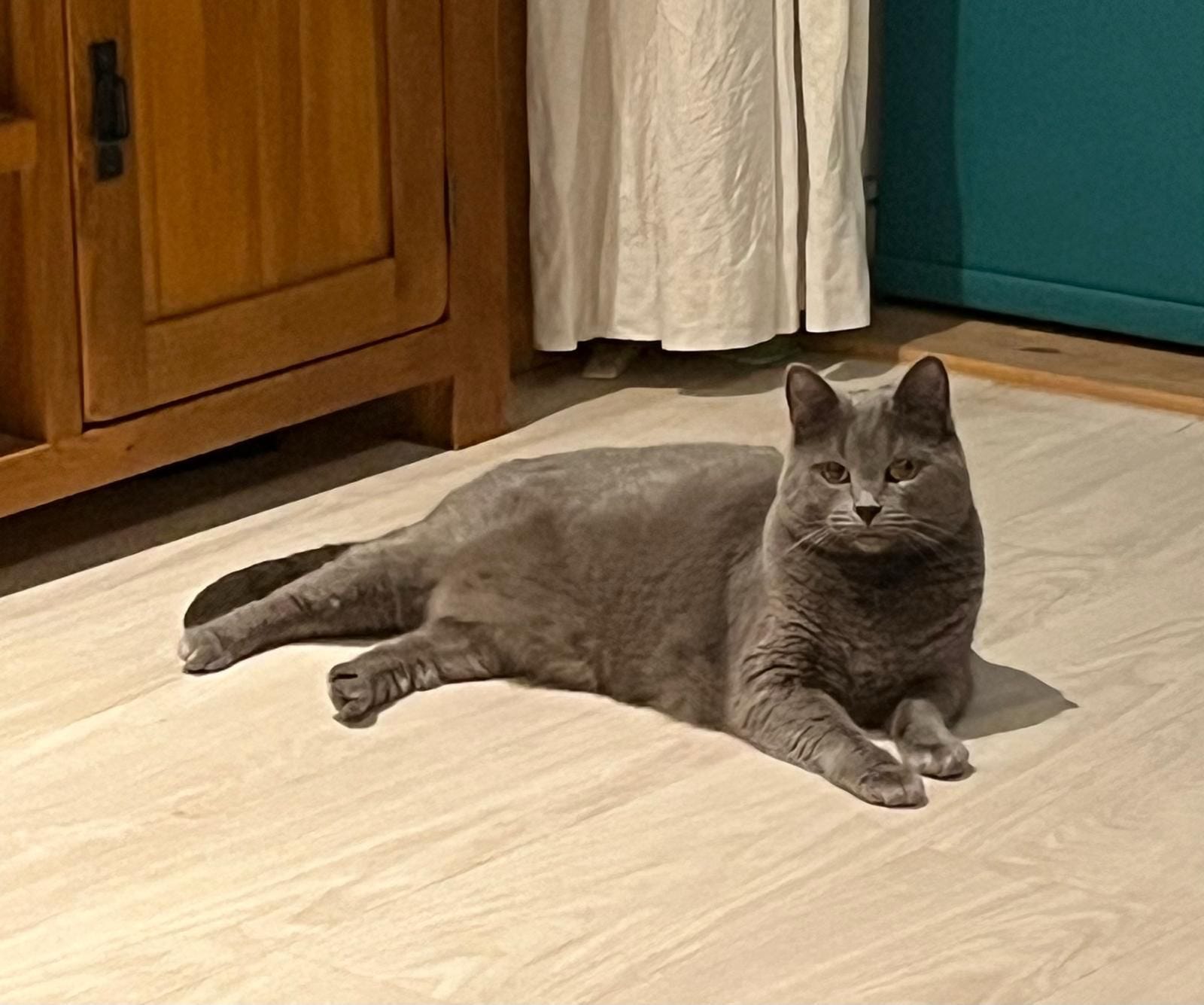
Absolutely love your new live in bestie! Very gorgeous. ;-) Is she going to have her own substack page and post too?:-)
This is another beautiful post, but you should never feel guilty about the effects your accident had on others, in as much as that no one is being coerced into helping you, loving you, and if you were actually a complete twat, which trust me, as a female philosopher, there are some hideous men out there in philosophy, you probably would not have the support you do. So the support you do have is probably grounded in others believing you are a good person, deserving of good treatment no matter what and you would do the same for them. And there is this huge thing in my mind, I fly paragliders, human society needs adventurers. Human society always needs outliers. People who question and challenge the edges of normality. Thomas Khun!!! Those people make society better, and we need them. Obviously you are one of those people, so it's natural for those of us who understand that society often only gets better by people pushing boundaries in every area of endeavour. Right now I give money and support animal activists who get arrested and sent to prison for protesting against climate change. I am a vet. As well as a philosophy. I give money to support people i do not even know who are supporting my cause. In the animal rights movement, we support our own. It's a natural feeling to want to support your own. All of us climbers and paragliders know the risks. You are getting supported because your mates love you. What happened to you could happen to anyone. Dont feel guilty because people love you.
This is so beautifully written and painfully self-aware. My two older boys have recently become enamored of climbing, so I have my own complicated feelings about Honnold. I made my boys promise they’d never free solo (perhaps that will hold), and other than that I have decided to trust them, forgive them preemptively for any mistakes, and then be a Daoist about the whole thing.