
Turning on a dime
Call me Temujin

Boys will be boys, we’ll be in it together
Until the fists start flying like they’re Conor McGregor
And then he’s out
I think he took it too far
I think the boy saw red, I think he hit him too hard
Now he’s face down on the pavement with a face full of tar
Mad how small altercations can define who we are.
- Ren
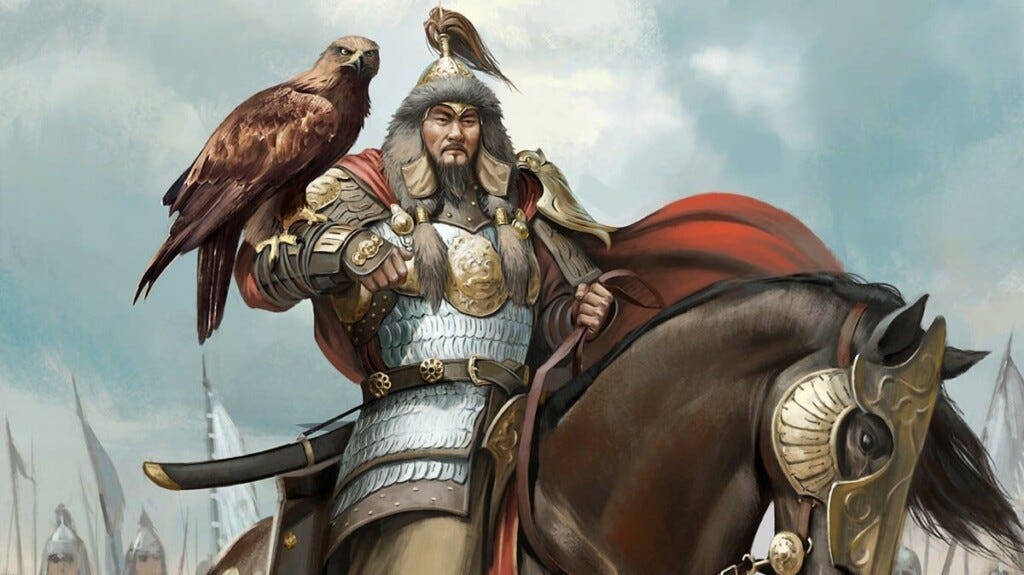
It is said that Genghis Khan was born with a blood clot in his fist. Prophecy, or curse? Either way all heroes need an origin story. Here’s mine.
When I was being born, medical staff decided it was taking too long. A forceps delivery was prescribed, and a trainee midwife told that she was about to learn. It being her first time, she didn’t get it quite right, missing my right eye by only a few centimetres. I was born bleeding, nearly losing an eye, and leaving a scar that I carry to this day.
What did this portend? Probably nothing, given that we live in a directionless universe where the only meanings are the ones that we create. Then again, it is my story, so my moment to create. And what I say is this: that was the first time that my life turned on a dime, going one way when it could easily have gone another – and where I lucked out. Because if there has been a theme to my life so far, it’s this: lucky bastard.
Which might seem odd coming from me, of all people. Ending up quadraspazzed doesn’t sound very lucky.1 But we’ll get to that.
Two pivotal moments in my life happened when I was 18. The first was the winter of 2004, when I was interviewed for a place to study at Oxford. It would be gratifying to say that my evident genius shone through; that I was always destined to transcend the expectations of the backwards, violent, Northern nowhere-town in which I was raised. But the truth is that the odds were firmly against me – and not helped by the fact that I royally screwed up the in-College aptitude test.
What made all the difference was that my interviewer pushed to take a chance on me (as I was later reliably informed). And I’m pretty sure that the only reason she did that was because she started the interview by asking: “why do you want to come to Oxford?” and I answered: “because I really want to learn about ideas, and where I come from nobody cares about ideas” (or words to that effect). I didn’t rehearse this, didn’t plan on this being my answer. (I didn’t go to the kind of school where we planned such things; only later would I learn that this put me in a minority.) It was just true. And I’m pretty sure that was what got me in. On paper I was good enough, but by no means amongst the best that they were interviewing. Yet my interviewer saw that I had something that most didn’t: a genuine and deep desire to learn. She pushed accordingly.
It could easily have been different. A different question; a different interviewer – and I would have fallen into the large pile of “good, but not good enough” failed applicants. Instead, I got what (for me personally) was a golden ticket. Access to 3 years of elite education, where I was fortunate enough to be tutored by an unbelievable cadre of dedicated academics, who genuinely cared about teaching. (And that too was lucky: by no means everybody who goes to Oxford gets that experience, nor has the temperament and the timing to lean in at that point in their life. In fact, most do not.) Those people taught me what it really means to think (and write). I owe my entire subsequent career, and hence much of what I am today, to that moment in the interview. (I needed the intense training, as I lacked the natural ability and temperament that is required to make it with less help.) My life turned on a dime – and from the perspective of who I then became, it was a moment of life and death. Because if the dime had turned the other way, the person that I later became would never have lived. I would never have lived. Somebody would have, for sure – but not me.
Less than a year later, just two weeks before I started at Oxford, another of those moments came along. And I nearly lost everything.
It was around midnight, outside the local Arts Centre. The weekly alternative music event had ended, and people were milling around on the street in various states of inebriation. I was actually sober, at that point going through my vegan straight edge phase. Suddenly, one of the local idiots was charging around. Clearly wasted, and trying to be the big man even though he was probably only about 17. He was threatening people, challenging anybody who would look at him to a fight. (And remember, this is in the context of a town where getting “taxed” for money, or your mobile phone, was a regular possibility when growing up. By this point, we were all sick of this kind of character.) However, I’d been Thai boxing regularly for about 18 months. I fancied my chances against this little prick.
But let’s stop right there and not pretend that this would be some act of chivalry on my behalf. I was not some aspiring MCU vigilante, looking to defend the innocent. My adolescent brain intuited an opportunity for status: maybe I could be the hard man. Also, the girl I was in love with (but too immature to understand that yet) was there, and I was stupid enough to think that movies and TV give you an accurate portrayal of what women are impressed by.
So I accepted the guy’s invitation for a scrap, and hit him hard. Way too hard. And in a way that you don’t hit people, ever, outside of the ring. The cross-elbow dropped him instantly, to the whooping approval of some of the men watching. As for the girl I was trying to impress? Well, you can guess how that played. I’m pretty sure it was the moment I screwed up my chances with her forever. Which was doubly unfortunate, because she was from a few towns over, and we’d first met because we were both going to Oxford. (Although as it happens we stayed friends, and still are. She inaugurated what became a lifelong pattern: I stay friends with my exes.)
Luckily for me, the guy got up again. But if he hadn’t? CCTV would have shown me voluntarily moving from a place of safety, to engage in a physical act of aggression, leaving a man seriously injured or worse. 18 years old, and with a martial arts training, I would have gone to prison. In a moment, my life turned on a dime – and I got lucky. He didn’t strike his head on the curb; I didn’t hit him in the temple in a way that can trigger aneurysm. We both walked away. And for the next 20 years, I’ve spent sleepless nights wondering: what if?
About a month before I fell off a cliff in Scotland, I was falling asleep in my van just outside the town of Hathersage in the Peak District. Suddenly, somebody started whacking the sides. Instantly awake, I pulled on some trousers and jumped out to find out what was going on.
A woman in her late 50s was hitting my van with a dog lead, shouting that I needed to fuck off. (I never saw the dog; not sure what was happening there.) I responded in kind and, erm, “advised” her to stop. Then a man appeared, probably in his early 60s. He was very short and scrawny, and like her quite clearly pissed out of his mind. They kept screaming some incoherent (and incorrect) nonsense about how I wasn’t legally allowed to park the van there. I told them that if they didn’t leave me alone, I was going to call the police. They said “go on, call the fucking police then!”. So I did.
But the 999 operator told me that because it was a bank holiday Sunday, and I was in the middle of the Peak District, it was going to be at least 90 minutes before the police could get there. After asking me to please stop shouting at the people and telling them to fuck off (fair enough) she asked if I was over the limit. I replied that I wasn’t. She then advised me to just drive away. This seemed like the best advice, so I agreed. I hung up the 999 call and then said something to the man. I can’t remember exactly what, but it would have been hostile: some attempt to assert status in the face of retreat. Not helpful for diffusing the situation. Anyway, whatever it was I did say, he hit me in the face.
Quite possibly the most pathetic punch I’ve ever seen anybody throw. It didn’t physically hurt at all, especially with my adrenaline up. But what it absolutely did do was trigger my chimpanzee response. Time to assert my alpha credentials. Left foot went forward, right hand went back. This guy’s nose was about to meet my fist.
But I hesitated. Two decades of periodic sleepless nights, thinking “what if”, flashed across my frontal cortex. And in the time that I hesitated, the guy took several steps backwards. (The look on his face made clear that he realised he’d made a mistake.) And in his inebriated state, he toppled backwards until he fell into a bush. More wasted than I had realised, he couldn’t get up, and lay on his back flapping his arms like a tortoise. Then the still-screaming woman tried to help him – and she fell into the bush, and she rolled around unable to stand. In that moment all of the adrenaline fell out of me. There was nothing to do but laugh at this pair of idiots. I drove away.
A few minutes later, cold realisation swept across me. If I hadn’t hesitated, if I had hit him, he would have gone down like a sack of potatoes and almost certainly smashed his head into the tarmac. We all know stories, from the kinds of shithole town I grew up in, where this has happened. At his age, at that level of intoxication? I am pretty sure that I would have killed him. My life had turned on a dime once again, and once again I walked away the winner.
A month later I fell off a mountain in Scotland and broke my neck.
Cormack McCarthy wrote: “you never know what worse luck your bad luck saved you from”.
For a long time, I thought that my life took a fork in the road, such that I have lived out the mirror image of this idea. I know exactly what worse luck my good luck didn’t save me from.
If I had hit that guy and killed him, it would have been awful. For a start, I would have killed a man, and had that forever on my conscience. A drunken idiot, yes – but hardly someone who deserved to die for it. As for me, it’s not clear how it would have played. My friend is a criminal barrister, and she says it’s unlikely that I would have been prosecuted. In part because it’s unlikely a jury would have convicted me, given that I had been the one asleep in my van, minding my own business, and it was me that first called 999. (When I told her the story, I wondered if her mind flashed back to that night when we were 18, outside the Arts Centre. Like I said, we’re still friends.) But who knows? Even if I hadn’t been sent to prison, I might have faced lengthy legal proceedings and uncertainty, lasting years. It could have cost me my career. It would almost certainly have cost me my mental health in serious ways.
But you know what wouldn’t have happened?
I wouldn’t have driven to Scotland a few days later, wouldn’t have been climbing in Glen Coe on a beautiful summer day. Wouldn’t have gone right, when I should have gone left.
Once more, my life turned on a dime. And this time, I did not walk away. That was the worse luck. And in the aftermath of the accident, I spent many sleepless hours wishing I could trade it for the bad luck.
Of course, I was made aware early on in my recovery that I was lucky – preposterously lucky – to be alive at all. And alive and without serious brain damage, given the injuries I sustained? It stretches credulity. Initially, friends and family were told to expect a vegetable, at best. Yet here I am.
This is an abbreviated list of the things that had to go right for me, after the rocks broke:
- Be climbing with a surgeon, literally the only climbing partner I had who could have kept me alive in the circumstances (and whose authority overruled mountain rescue’s initial plan to get me out on foot, which I wouldn’t have survived)
- A second climbing team catching up with us after only 20 minutes, who were able to get out onto the face of the mountain to access the phone signal required to call 999
- Perfect summer conditions (in Scotland) allowing a helicopter to reach us; given where we were, any wind at all would have made a rescue impossible
- Being only a 10-minute helicopter ride not just from a hospital, but from the world class spinal injury unit in Glasgow
- Having world class plastic surgeons, who performed a difficult skin graft required to prevent my left arm needing to be amputated below the elbow
- In general, being so physically fit at the time of my accident that I was able to survive a period of trauma that doctors say would have killed most people
- Not having suffered a single significant setback related to my injury since regaining consciousness, allowing me the best shot at rebuilding a life
The problem was that for the first two years after waking up I found it hard to believe that these were instances of good luck at all. Paralysed, with my life in tatters and my mind shredded, it seemed evident that the worst luck was surviving the accident. Better to never wake up from a fall like that.
Indeed, as I wrote fairly early on, one of the things I could not abide was people telling me: “at least you still have your mind!” It seemed to me like my mind was the goddamn problem. That the cruellest thing possible was to leave that switched on, but with everything else disconnected.
It doesn’t seem that way anymore. It is true that I spend a lot of time on my own these days, and I still miss climbing, physical activity, more than I can properly describe. But I now don’t get bored all that often. The trick, I discovered, was to lean hard into the one thing that I still have: my mind.
Prior to the accident, my career was very much taking a backseat to my climbing. Well, I’m now putting more effort into my career than I have since my 20s. (By which I mean: reading, writing, and teaching students the best I can. I DGAF about promotions; nothing like near death to put the rat race in perspective.)2 The time I used to spend training for climbing is now diverted to reading history, philosophy of mind, literature, whatever takes my fancy. And while it didn’t happen overnight, this Substack has itself opened the door to writing gigs at prestige outlets. I’m in the middle of recording a series for a high-profile history of ideas podcast (more in due course). Hell, I’m even starting to get into classical music, if only because psychedelic death metal isn’t always the easiest thing to have on when you’re writing.
This isn’t the life I wanted, isn’t the life I would have chosen. But what the McCarthy quote obscures is that luck is not usually either/or. This isn’t usually the last dime.3 It’s true that my life turned, in a pretty significant way, on one of those dimes. But what I’ve slowly come to appreciate is how many more dimes were still to come. It’s true that I cannot walk away, in a literal sense, from any of them, ever again. But if I look back at my life over the past 2 ½ years, it looks like the pattern set at birth held, after all.
I wasn’t born with a blood clot in my hand. But I am one lucky bastard.
Even if no longer on a life glug.
Christ, how lucky am I to still have a career, to have been doing pretty much the easiest job it is possible for a tetraplegic to go back to (not least thanks to the wonders of modern technology, unavailable to earlier generations)?
Except when it is, of course.
I've been reading your blog since Hanif Kureishi mentioned you in one of his posts while you were still in the hospital. I have found your essays to be incredibly moving, instructive (as in, I've learned a lot), thoughtful, and deeply meaningful. Your stories have made me infuriated on your behalf numerous times, but have also led me to cheering your victories — even the ones you said were small. At the time I started following you, I was going through my own health issues and could commiserate with frustrations related to medical situations; more than that, since my entire career has been related to working with people with disabilities, you have had me thinking deeply about society's attitudes towards "able bodies vs. disabled bodies."
Your last few posts have moved me to happy tears. You write so beautifully about where you've been and where you are now in thinking about how your life has changed so dramatically. It's rare to read such honesty and clarity about acquiring a severe disability like this. Your own wonderful intellect and gifts of expression have provided me with so much to think about and share with my students and I thank you. I am more appreciative than you know.
This reminds me that I meant to comment on the post w/the Gauguin hypothetical, but didn't want to get into the weeds of free will with a philosopher, lol. But I'm very much of a mind that temperaments and dispositions, too, are accidents of fate; and so the choices we make are downstream of that randomness. A more-circumspect version of you may have made the right judgment calls that fateful day in Scotland, but he may also have deprived himself of some truly awesome experiences prior to that out of caution. Who/what decided how inherently risk-taking and adventure-seeking you'd be?
Similarly, who/what decided that you'd have the temperament to lean in to getting the kind of academic tutelage that helped you flourish? Sure, we build our own characters and make our own decisions to no small extent, and we owe it to ourselves to shore up various "deficiencies", but a lot of how we are (cognitively, emotionally) is handed to us, not unlike talent for painting or philosophy, no? (I should also note that I think some of this is cultural; I come from a "don't impose on people" culture, which in some unfortunate default ways translates to "don't ask for help".)