
Forms of Failure
Or, why moral luck is a bitch

I recently attended two weddings, one in Carlisle the other in Edinburgh. I’m glad I made it to both. Partly just because staying away from home, as well as travelling, is now a logistical nightmare full of trepidation, and so pulling off both successfully felt good. Partly because when I initially accepted the invitations I had secretly told myself that I wouldn’t actually go – and so deciding No, I damn well will go, and following through, also felt good. But mostly just because they were fun days, surrounded by a lot of good people, many of whom I’ve known for years but was seeing for the first time since the accident, and all of whom treated me no differently than before. Two of my good friends did something special, which I could be a very minor part of, and that was great.

So, I do not regret going. But I’d be lying if I said it was simple for me to just enjoy such occasions, great as they are. For a start, it’s hard not to feel acutely self-conscious. I can see guests who don’t know me wondering who the disabled guy is, about his connection to the happy couple. Too polite to ask, of course, but it compounds the sense that my proper place is in the freakshow: next to the bearded lady, a warmup for the elephant man. “Roll up! Roll up! Witness the living corpse!” And it doesn’t help that I used to really enjoy weddings, back before the catastrophe. A great opportunity to catch up with friends, drink too much, dance badly to music of varying quality, and confirm that the premise of the movie Wedding Crashers is completely accurate. I’m a long way from those days now. The comparison stings.
I was always pretty sure that I myself would never get married. Or that if I did, there was no way I was going to have anything like a conventional event. Whilst I absolutely love other people doing the whole shebang, the thought of going through that rigmarole myself never appealed. The endless planning, the vast expense, giving up an entire weekend of climbing, having everybody stare at me whilst I performed the absurd traditions that I like to stare at other people performing? That always looked like too much effort for just one party. Plus, I quietly suspected that my life would be characterised by a series of medium-term relationships anyway. If I did by some fluke meet The One I Was Meant To Be With Forever, then we would just stay together because we felt like it, not because we had a piece of paper saying so. And if the fire went out, well it would be much easier to both walk away, heads held high and mutual respect preserved, without the messy acrimony of divorce. It also helped that I never really wanted children: too many rocks to climb, too many fish to capture, too many books to read, etc. I just figured that family life would be for other people. And that was fine.
But things can feel different when they are taken away, rather than being passed over as a matter of choice.
It’s not that I now want to get married, as such. I still feel roughly the same about weddings: I love other people’s, with no desire to host one myself. But the rub is that hosting one myself isn’t even going to be an option anymore, or at least it certainly feels that way. The chances of meeting somebody that I am both physically and psychologically attracted to, and that they reciprocate in the direction of this carnival grotesque, and that I let them get close enough for anything to happen, I estimate at functionally zero. I now operate on the assumption that I’m spending the rest of my life alone, romantically speaking.1
And from what philosophers sometimes refer to as the cosmopolitan point of view, that may not be a bad thing. My track record with women was that I seemed to have a peculiar ability to destroy their self-confidence and make them unhappy. It’s not that I ever tried to do this, or meant to. It’s just that being with me was fucking hard work, probably a function of the fact that I survived into adulthood by making myself as emotionally self-sufficient as possible. While it sucks for me, and I won’t deny that I am lonely having to live the way I do now, the hard truth is that it is probably better for womankind if I’m confined to the friend zone.
Still, weddings have a knack for making that hard truth hit home. To some extent, it’s just because so many people that I know have managed to get it right. Many friends have found good, fitting partners, and a fair number have started their own families accordingly. Seeing them assembled, it’s difficult to escape the nagging thought: how is it me, out of everyone, who’s ended up alone? And then I think about the fact that there have been some truly fantastic women in my life. Why couldn’t I make it stick with one of them, and who knows, maybe even have paid her more attention than to the stupid rocks? The stupid rocks that got me into this mess…
All of which feeds the overriding sense that I am, ultimately, a failure. At which point I hear the voice of family/friends/therapists objecting: “But you didn’t fail, you had an accident!” And of course, I see what they mean. There is a sense in which it is obviously correct. But there’s also another, deeper, sense in which it is too simple a dichotomy; in which accident and failure do not come so neatly apart. Thus bear with me (or, y’know, go and read something less depressing) whilst I take a tour through my latest reflections on the philosophical problem of moral luck.
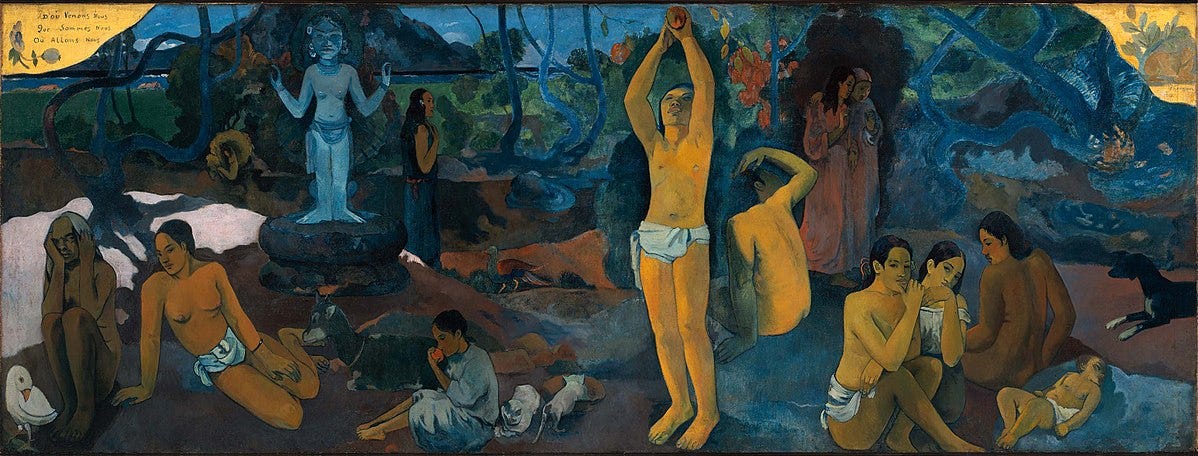
It’s useful to start here with what has become a classic example in the philosophical literature: a stylised version of the story of Paul Gauguin.2 Imagine a painter, let’s call him Gauguin, who has a wife and family. However, he feels a deep impulse to move to Tahiti to try and realise his abilities as a painter. Unfortunately, realising these abilities will require him to abandon his wife and family (for whatever reason, he needs to go to Tahiti alone, and dedicate himself single-mindedly to painting). Importantly, Gauguin fully recognises that this is a seriously weighty choice. He does genuinely care about his wife and family. (In many ways, the scenario would be much simpler to appraise if he was a selfish amoralist who didn’t care about them in the first place. But he isn’t.) The problem is, he also cares deeply about trying to actualise his potential as a painter. We might suppose that he has been reading D.H. Lawrence, and endorses Bernard Williams’s (mis)quotation of the English novelist: find your deepest impulse, and follow that.
Now let’s suppose that Gauguin decides that, yes, painting is his deepest impulse, and so he must follow that: he really must move to Tahiti. He thus takes the weighty decision to abandon his wife and family. But unlike the real Gauguin, let’s imagine that our fictional Gauguin does not succeed in becoming an excellent painter. (Important: this is not a question about whether other people think his paintings are excellent or not. Van Gogh, after all, produced excellent paintings that almost nobody really appreciated until after he was dead. We mean here that our fictional Gauguin produces paintings that are in the end just mediocre, by anybody’s reckoning, including his own.)
There are at least two distinct ways, however, in which Gauguin could fail to become an excellent painter:
1. On the ship to Tahiti, Gauguin develops an infection which leads to sepsis, and ultimately has his hands chopped off to save his life. After this, he can try strapping paintbrushes to his stumps, but he lacks the dexterity required to produce the art that he set out to make. He does his best to paint the natives of Tahiti, but his paintings are mediocre at best.
2. Gauguin makes it to Tahiti just fine, and sets out trying to paint the natives. But it turns out that…he’s just not that good at painting. He tries his best, but excellence eludes him. It turns out he never had the artistic spark required for greatness, after all. His paintings are mediocre at best.
These scenarios appear, however, to generate different implications regarding what Gauguin might say to himself, in the wake of failure, about his decision to abandon his family.
(Important: there may be nothing he can say to his family, or even the rest of us, in terms of justifying his abandonment of them, at least not that they or we could be expected to accept. Even if he had succeeded in becoming an excellent, even world-historical painter, they [and maybe we] would still be entitled to say that this doesn’t matter. That his first responsibility was to his family, and his betrayal of them cannot be justified by anything, not even world historical artistic excellence. Gauguin, not being an amoralist, accepts that they are right, and feels his moral failing keenly. It’s just that, for now, we are focusing on what Gauguin can say both to and about himself, if we first accept that painting truly was his deepest impulse.)
In both scenarios, Gauguin’s decision to abandon his wife and family looks, in retrospect, unjustified. Not only did he let them down, but he also failed to become an excellent painter: he must thus appraise himself as having more fundamentally failed in his quest to follow his deepest impulse. His acceptance of letting down his loved ones was the price he was originally willing to pay to try and bring that about. But having failed, that is a price it turns out that he should never have paid in the first place.
Yet the way in which his decision to follow his deepest impulse ends in failure is importantly different in each case.
In the first scenario, he was subject to what we all recognise as bad luck. If he hadn’t caught sepsis, then he wouldn’t have ended up an amputee unable to hold a paintbrush. Perhaps he would have been an excellent painter, if only he hadn’t lost his hands. But he did, and his painting career is a failure, and so he cannot retrospectively justify (to himself, and especially not to them) his decision to abandon his family as a necessary step for him to succeed as a painter. Because he failed.
The second scenario is different. His failure to become an excellent painter here is generated not because of some external piece of bad fortune, but because it turns out that he just didn’t have what it takes. Unfortunately, he had to go all the way to Tahiti, after abandoning his family, to find out this brute truth. But having now found it out, he cannot retrospectively justify (to himself, and especially not to them) his decision to abandon his family as a necessary step for him to succeed as a painter. Because he failed.
Interestingly, however, the second scenario is also a function of a luck. After all, whether or not Gauguin had what it took to become an excellent painter – whether he had that ‘special something’ inside him required for artistic genius – is ultimately down to luck. A few people have it; the vast majority don’t. Whether or not you do, it’s not under your control, but down to fortune. (Just pray that if you think you might have it, you don’t need to move to Tahiti and abandon your family to find out.)
But whether these matters of luck happen because of external factors beyond one’s control (like getting sepsis), or arise because of internal factors about what one turns out to be fundamentally capable of (like being unusually good at painting) seems to make a very important difference in appraising one’s own past actions.
After all, the Gauguin who failed because he lost his hands can always hold on to the thought that maybe he ultimately would have been justified (to himself, if not to them) in abandoning his family if only he had not lost his hands. Alas, he’ll never know, and of course he will probably wish that he’d never left for Tahiti in the first place (that way he could have kept not only his family, but also his hands). As things came to pass, his decision to abandon his family looks unjustified (it ended in the failure of his project to be a painter, but that project needed to succeed in order to justify the initial abandonment). But there is a parallel sense in which he himself was not unjustified in doing so, i.e. in terms of thinking that he had to move to Tahiti to try and realise his excellence as a painter. In the end, external luck intervened, meaning that he never got to find out whether he could indeed have been an excellent painter; whether he might, in the end, have been justified (at least to himself) in abandoning his family in the pursuit of that goal.
By contrast, the Gauguin who makes it safely to Tahiti and discovers that he just isn’t that good at painting is in a very different position. He cannot make use of the thought “Alas, I never really got to find out if I had what it takes!” He did get to find out, and it turned out that he didn’t. Yet he too needed that project to succeed to provide a justification (at least to himself) for abandoning his family and trying to become a great painter. But he has no such justification, and it turns out that he never did. Not only is there nothing he can say to his family to justify having abandoned them, there is nothing he can say to himself that can finally justify his having done so, either. (The most that he can say is “Well, I had to find out” – but having found out, it turns out that he shouldn’t have tried to find out after all.) In the second scenario, Gauguin is in a sense himself fundamentally unjustified, over and above his actions of abandonment. He has nothing left to say in his own defence – even to himself, let alone to anyone else. And that seems to be why we think the second scenario is somehow worse, more penetrating in its generation of failure, than the first. Both are a function of luck, one external and the other internal. But failures of internal luck seem to cut deeper than “merely” suffering the slings and arrows of outrageous fortune.
Where am I going with this? I was always a rubbish painter, but I feel a kind of affinity to the (fictional) Gauguin. Admittedly, my situation wasn’t initially as dramatic as his decision to bugger off to Tahiti. It wasn’t that I abandoned a wife and family, as that I basically elected not to have one. While I think my parents are disappointed that they won’t get a daughter-in-law, 2.5 children, and a Labrador,3 I think they’d figured out some time before the accident that it was going to be that way. But the point is, this was very much a choice of mine. I didn’t want a conventional life. My deepest impulse was climbing up bits of progressively more difficult rock, and orientating as much of my life around that inherently daft activity as possible. I was following that. I didn’t want to settle down, have a wife and kids, a “normal” existence. I wanted a life of adventure, as much of it as possible spent living out of van with maximum access to nature, having conveniently found myself a career which provided massive potential to do so.
But then I fell off a mountain and snapped my neck. In that instant I lost my life of adventure, but also any chance at the kind of happy conventional life that I’d traded it in for. Instead, I got something decidedly worse than either.
You might be thinking “True, but at least it was just a case of bad external luck, as profound and horrible as that turned out to be”. The thought here being that my situation is roughly equivalent to the Gauguin who fails because he loses his hands, rather than the one who fails because he just isn’t good enough at painting. After all, rocks snapping looks like a paradigm case of external bad luck: something entirely out of my control. Can I not therefore take comfort in the fact that if the rocks hadn’t snapped, then my decision to renounce a conventional life would perhaps have been justified after all? That while my project failed, a result of bad luck, there is a sense in which it wasn’t me that more fundamentally failed. (That, precisely, I didn’t fail, I had an accident.)
Unfortunately, I don’t think so. It’s messier than that. After all, it was a necessary part of my project of living an unconventional life that I was happy to put myself in dangerous scenarios. It wasn’t just that I backed my own ability to succeed physically and mentally, it was also that I backed myself to make the right judgement calls about which scenarios I was choosing to get into in the first place. And in the end, I got it wrong. I moved too quickly, too confidently, on an occasion where going more slowly, more cautiously, would have made all the difference. True, it was an easy mistake to make. Many others, with my level of experience, would have made it too. But they didn’t, and I did. It wasn’t just that the rocks snapped. It was that I got it wrong. I thought I was good enough to not get it wrong. It turns out that I wasn’t. I failed accordingly – and thus had an accident, which not only changed everything, but unjustified me in the process.4
Still, there’s an important way in which I resemble one fictional Gauguin more than the other. In both cases, once they have failed, we can imagine them regretting that they had ever even tried to succeed. The Gauguin who caught sepsis will likely regret setting sail for Tahiti because this cost him both his family and his hands, and for which he now has nothing to show. The Gauguin who failed as a painter because he just wasn’t good enough at painting will regret that he lost his family and that he turned out not to be the creative talent that he hoped, and for which he likewise now has nothing to show. In both cases, we might expect them to regret ever leaving France – but for importantly different reasons. The first Gauguin can still say “At least I tried!” But as we have seen, the second cannot. The former can regret that things went wrong, but need not necessarily regret that he tried. The latter must regret that he even tried; his regret cuts deeper into who he is.
I regret that we picked that route on that mountain on that day; that I didn’t climb more cautiously, more slowly, with more care. But I don’t regret that I became a climber. The years I spent in the mountains were the best years I ever had. Part of what hurts about losing them is knowing that I’ve experienced things that most people never will – and the advantage that they now have over me is that they don’t even know what they’re missing, and so it can’t hurt them to miss out on it. But I do know, and always will, and it hurts me accordingly. The bitch of a kicker is that they get to have the comforts of a more conventional life, but I’ve now lost those, too. I gambled, and I failed. The debt has come due accordingly.
Still, I don’t regret it. I think I’d probably do it all over again if given the chance. At the wedding in Edinburgh, one of the guests I didn’t previously know asked if he could have a chat about climbing and my accident. He’d recently made the transition to outdoor trad routes, and was understandably somewhat unnerved by my story. I gave him a frank rundown of what happened, what went wrong, and how close I came to snuffing out the candle once and for all. The lingering question he wanted answered, of course, was: should he pack it in now, before it was too late?
I gave him the only honest answer I could. To always appraise the risks, and always keep in mind that things might indeed go very wrong. But if he was comfortable with those risks, in full awareness of what might go wrong (regarding which: check out the example sat in front of him), get on out there. I would if I could.
If the devil came to me tomorrow and said he would cure my paralysis on condition that I never climbed again, or else he would send my soul to hell for eternity, what would I say? The sensible part of me would have to turn him down and stay paralysed, knowing that I would instantly break the deal. But the sensible part of me would lose. I’d worry about my soul’s journey through eternal hell when it got there. Until then, I’d be back on the cliffs more quickly than I could shake the devil’s hand.
It doesn't help that in the modern world, most people meet romantic partners through online dating apps. If you think I'm sticking pictures of my broken fat self on Tinder for thousands of women to reject, then I want some of what you're smoking.
The real historical Gauguin’s situation was a good deal more complicated, it turns out, but I will stick with philosophical convention and shit on his posthumous reputation.
Actually, I’d like to think that one day I might still get a Labrador. Preferably a clever one that can do things like put my shoes on for me. Apparently, they do exist.
For the moral philosophy nerds: if we go back to Williams’s classic paper, this probably means that I’m closer to Anna Karenina than Gauguin. The mountains were my Vronsky. I loved them, and gambled my life project on their loving me back. But in the end, they didn’t. My intrinsic bad moral luck was thus not located entirely within me, but to some important extent also in the rocks.
When one is more housebound than one would like, eccentricities are guaranteed to surface. One must allow oneself to go a little bit mad in order to stave off a larger all-encompassing madness. Like the ghostbusters at the end film Ghostbusters, who are instructed by the pan-dimensional entity, Gozer the Gozerian, to choose the form of their destructor (in their case the Stay Puft Marshmallow Man, who briefly terrorises Manhattan) we get to choose our idiosyncrasies. But what will it be in your case? Perhaps a ruthless ascent through the echelons of the UK wing of the Taylor Swift fan club? No, apparently it will be Paul Gauguin fan fiction that stops just short of injecting itself into the Twilight universe.
I have plastic figure of Ponda Baba (known pejoratively as ‘Walrus Man’) from the first Star Wars film. You can pull him arms and hands off to simulate the savage lightsaber injuries that are dealt to him by Obi-Wan Kenobi in the Mos-Eisley Cantina. Since I have no frame of reference for Gauguin, I am going to imagine both speculative versions of the artist (with and without hands) as Ponda Baba. This will help me to visualise the problem. I will stare at the Ponda Baba figure and I will say to him “You are Gauguin now”. Then I will pull his hands off.
What does it mean to be a successful artist? Anyone who has seriously engaged in a creative medium, and who has worked at it daily, will tell you the ultimate value lies in the ongoing process rather than in the reception of what is produced. That was as true with (the late Beach Boy) Brian Wilson, composing his teenage symphonies to God, as it was with (the also late) Seth Putnam from Anal Cunt, recording himself singing improvised lyrics regarding the baldness of Earache Records Sales Director, Howard Wulkan, over a compilation of disco classics that was playing in the background, and then releasing the session as a seven-minute concept album titled ‘Howard is Bald’. When the focus drifts from the process towards the impact the art might have (something you have minimal control over), one loses connection with one’s vision, the process is compromised, the art suffers, and it’s a miserable experience. I would define a successful artist as somebody who uses the means at their disposal to engage with and express their vision. There may be an element of cope in that interpretation.
Let’s say Gauguin doesn’t give a damn about vision or process. For him, being a successful artist entails throwing paint at the last known location of the zeitgeist in the hope that something sticks. It is about garnering enough fame and money to extract a good living from the dog eat dog Tahiti art gallery scene.
You present two versions of misfortune. There is the external variety where Gauguin loses his hands as a result of some stroke of damn bad luck beyond his control. Then there is the internal variety where Gauguin simply lacks the talent to make it as an artist, but is only able to learn this hard truth a posteriori, through trying and failing.
I don’t think it’s as cut and dry as that. I think in the latter instance of internal bad luck, there is a hell of a lot of external luck involved. First of all being a successful artist in the tangible sense of the word entails more than artistic ability. You need to be able to market your art and yourself as a package – to convince others of the value of both. Let’s say that Gauguin is able to do that. He might still fail to become the toast of the viciously competitive Tahiti art world as a result of a host of external factors that are beyond his control. His art might not connect with the public appetite – it might be ahead of its time. Other new artists might be dominating the spotlight. He might fail to connect with the right people.
I am writing about The Divine Comedy (the band, not Dante), which is essentially Neil Hannon and whoever he is working with. I remember the ‘band’ as they were in the early nineties. Hannon disowned his debut album. He went on to release a pair of albums that received critical acclaim but didn’t chart. His talent was evident but he was not successful, though I think that perhaps a haircut that didn’t make him look like a Bond villain would have helped. Then he caught a break. Chris Evans began playing ‘Something for the Weekend’ on his Radio One show. This gave Hannon’s work exposure and allowed him to generate the momentum for a career in music that continues to this day.
Hannon’s abilities as a songwriter certainly played a part in his success. However the deciding factor were the actions of a man who had the wherewithal to expose his music to a wider audience. What if that hadn’t happened? What if the stars didn’t align for Hannon? Is he a failed artist? I don’t think so. If he possessed a god-like knowledge of the steps that were required to achieve fame and fortune and then still managed to fuck it up, then I would say ‘yes’. It goes both ways. This morning I was listening to Jack Pepsi by Tad, who were briefly signed to Warner Bros, less on the basis of the quality of their music, and more because Nirvana and Soundgarden were shifting units for other major labels. The minimally talented Menswear were signed to London Records during the Brtipop feeding frenzy. On paper they were successful artists. In reality they were just lucky. They were in the right place at the right time and they knew the right people. Ability didn’t really factor in.
You are venturing outdoors with increased frequency which is heartening, and speaks of a man who is not yet done with life and who is courageous. When you embark on a journey I expect there is some forward planning. What if one of these outings goes badly wrong, despite your preparations. Are you a failure because external factors beyond your control, and maybe even beyond your knowledge, intervened? The failure is to stay at home because something bad might happen.
Regarding your proposed deal with the devil, I would want a very precise definition of ‘climbing’. Does standing on a chair to reach something on a high shelf count? What about the kind of social climbing that might come as part and parcel of your bloody and brutal rise through the ranks of the Taylor Swift fan club. You are a clever man, but the devil is smarter than you and he’s played the game longer.
Fascinating piece, Paul. You are a great thinker and a great writer. Please keep on keeping on!